Table of Content
You'll spend up to $300 more for better efficiency in a reverse osmosis system. All of these chemicals find their way into streams, reservoirs, and then ultimately into your home. Intheir report, the EWG recommends finding a good water filter system for home toremove dangerous chemicals from your drinking water. Home Master RO systems can remove common tap water contaminants such as Arsenic V, Barium, Cadmium, Chromium, Copper, Cysts, Fluoride, Lead, Nitrates, Radium, Selenium, and Turbidity. RO carbon filtration can also remove a huge number of chemical contaminants, such as antifreeze, bleach, chlorine, detergents, gasoline, lactic acid, and many more.

Home Master Reverse Osmosis System—Owners Manual the lower cabinetry, high along the back wall just below the drawers. Make sure cabinet contents are removed, prior to drilling, and ¼” tubing does not come into contact with drawers, doors, or sharp objects. Smooth the holes free from splinters and sharp edges. The filters and UV bulb are changed every year on UV equipped system, every 3rd year the entive UV module is changed. It is a good idea to keep a set of spare orings—1 per housing. You may need to change them each time you open the housing.
Undersink RO Replacement Filters
You may share the water report with us, if you would like a personal recommendation. The average person spends about $1,500 on bottled water in a year. A few factors that affect a system's cost include its efficiency, the number of stages, and if it has an NSF certification. Find hiring guides, material costs, expert advice, how-to's and more. Use your thumb and forefinger to push down the collet ring while also pulling the tubing. Trim ¼” from the tubing’s end, and make sure it is smooth and rounded.
Also, a light/ empty tank may indicate a production problem, and a heavy/full tank a tank problem. Another thing to take note of is that each RO system uses a catalytic carbon filtration media inside of the carbon pre-filter. This treats chloramine, which is commonly found in municipally-treated water.
Home Master TMULTRA-ERP
Point-of-use reverse osmosis systems run around $150 to $1,300. Before we dive into what these filtration systems can offer you, let’s break down the names. The Home Master TMAFC is the Artesian Full Contact Reverse Osmosis Water Filtration System, whereas the Home Master TMAFC-ERP is the same system but with a permeate pump. The TMAFC-ERP-L is the Artesian system “loaded” with extras in addition to the permeate pump. We can confidently say that the Home Master Artesian Reverse Osmosis System is one of the best undersink water filters. The Home Master TMHP Hydroperfection is a highly advanced 9-stage water filtration system with a modular design.

In the worst-case scenario, you can bore a new hole in the sink deck or countertop to hold the filter's spigot. Although the physics of how reverse osmosis filtration works are complicated, installation is fairly straightforward, requiring only basic plumbing skills. Changing the filters or membrane is the most common course of action to resolve a poor taste problem. Tubing cannot be pulled out without depressing the collet ring, and relieving system pressure.
Average Cost of a Reverse Osmosis Water System
The ISetTMA8 will need to be replaced annually, and the membranes should be replaced every 3-5 years. Install the filter's sink-top spigot first so you can get the lines down under the countertop before it gets too crowded beneath the sink. Mount the RO spigot to the kitchen sink deck or countertop with the hardware provided. Many sinks will have an existing knock-out opening that can be used for the spigot. Sometimes the knockout intended for a sink sprayer can be used for the filter's spigot.
In some 5-stage systems, the storage tank water also goes through a "polishing" filter on its way to the sink-top spigot. Most reverse osmosis systems go under the kitchen sink but they can also be installed in a remote location such as a garage or utility room, then be run up to the sink location. The filter system needs to be installed on the cold water line past the water softener if your home is equipped with one. Remote installation does not take up any room under the sink, but it does require more work to install.
Commercial reverse osmosis systems require high flow rates and storage capacities, so you’ll never use a residential system in almost any business setting. Commercial or large reverse osmosis systems cost around $4,000 to $25,000, not including installation, which can range from $500 to $2,000 or more. One minor repair issue you may run into with the TM and its TM ERP-L counterpart is fine air bubbles. Air is trapped inside the pores of the carbon and is gradually released. All you have to do is wait a few seconds for the water to clear after you’ve poured a glass of water. The TM is one of Home Master’s most basic filtration systems, making it an excellent option for households on a budget.

However, one brand's seven-stage filter might cost less than another brand's three-stage system. Installing a single-tap or point-of-use RO system costs around $150 to $1,300. These systems get installed under sinks, behind refrigerators, and near washing machines, depending on where you need them. We not only install but also service and repair all of the above systems,even if your filter was installed by another company.
Reverse osmosis water treatment repairs cost $150 to $800 on average. Standard reverse osmosis systems utilize canister filter housing, in which only filters are changed – not the housing themselves. Over time, this can lead to a buildup of sediment, biofilm, and microorganisms. Over time, the canisters will weaken and inevitably fail, potentially leading to water damage and expensive home repairs. Reverse osmosis filtration cleans your water better than almost any other system and saves hundreds over buying bottled water. Installing a whole-home reverse osmosis system costs $2,200 on average, or between $1,000 and $4,800.

Some Home Master RO models add calcium and magnesium ions into the water, letting you get pure mineral water with a great taste straight from the tap. Home Master reverse osmosis can make your drinking water safe and delicious – but how? Because of the RO systems’ advanced filtration , up to 99% of contaminants can be removed. Since 2002, our filtration systems have stood alone in quality and performance. Others focused on cost cutting – we focused on build quality. The competition brought in foreign components, while we patented new technology.
For a whirlpool reverse osmosis system, a drain tee is included. Position the filter's tee fitting up against the existing drain pipe, then mark and cut the pipe, using a hacksaw. When making the cuts, make sure that the tee will fit tightly. When connecting the tubing, use the extra length of the tubing to your advantage and run it to the back of the cabinets or wherever necessary to allow for the cleanest installation. If possible, leave extra tubing in case the system needs to be moved at a later date.

One Home Master Ultra repair you might need to make is fixing odd noises. If you hear troublesome groaning sounds, you can pull the system off of the mounting clips, rotate it to the left by 90 degrees, and hold it there for 10 minutes. As with the other models, the TMULTRA is the basic package, whereas the TMULTRA-ERP comes with a permeate pump.
There are very few parts to a reverse osmosis system, making it very easy to clean and maintain. If the health of your family, the environment, and your finances is important to you, then consider a water treatment system fromHigh Water Standard. For the price of a year’s supply of bottled water, you can have clean, filtered water in your home all the time. Our water filter installation service takes as little as two to three hours and can provide a lifetime of enjoyment and peace of mind.
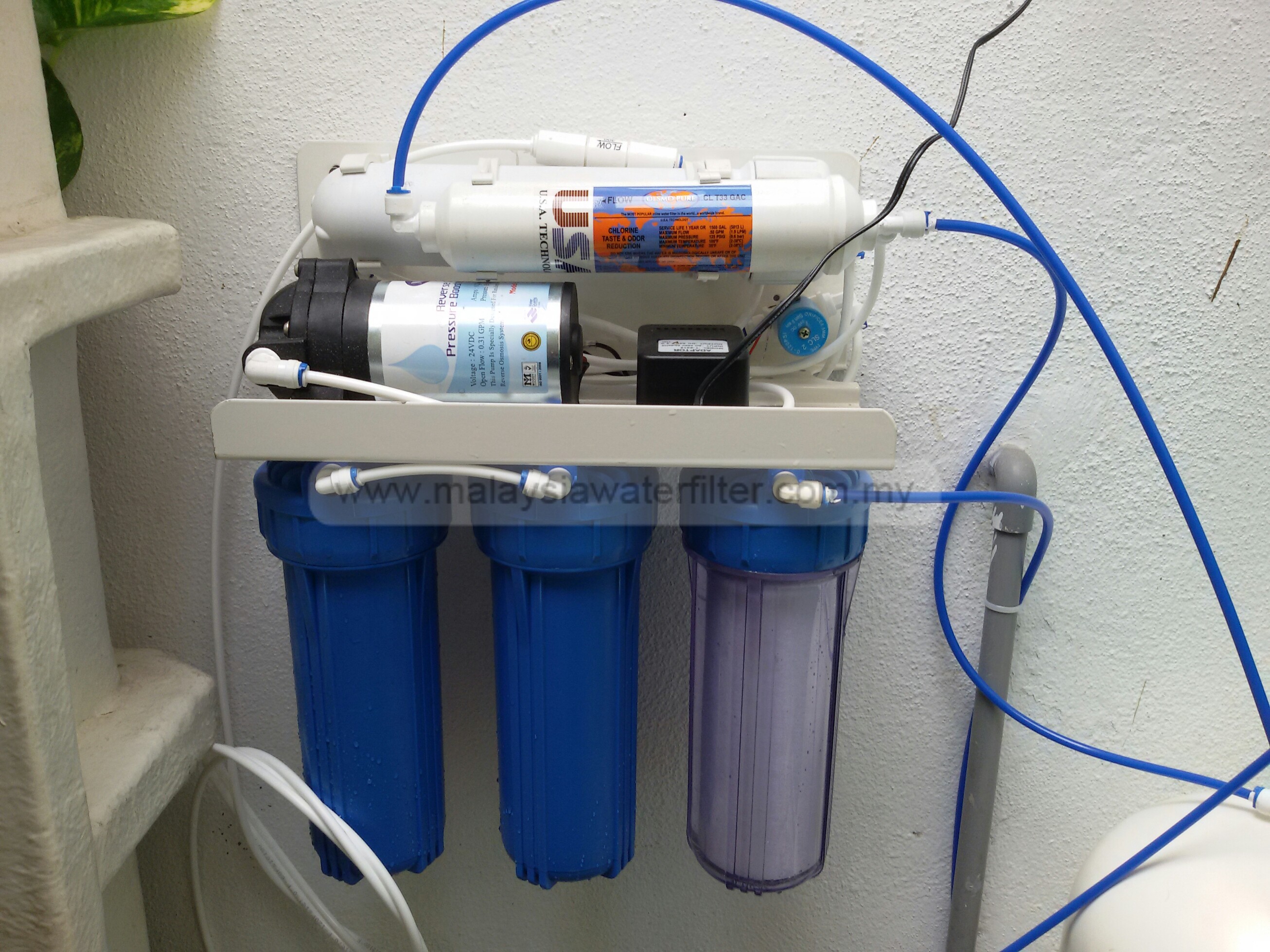
If the sink faucet uses flex tubes of a different size, however, you'll need to use an adapter tee to make the transition to the water supply tube running to the filter unit. The green supply tube is connected to the adapter tee with a nut, ferrule, and insert. Also, make sure you have an idea of what cold water source can be used. Most units come with a tee connection that taps into the 1/2-inch cold water supply line going to the faucet. Other RO units use a 3/8-inch flex line that comes down from the faucet.




No comments:
Post a Comment